Rawmarsh Ryecroft Infant School – Equalities Information and Objectives
Aims
Our school welcomes our duties under the public sector equality duty by having due regard to the need to:
- Eliminate discrimination and other conduct that is prohibited by the Equality Act 2010
- Advance equality of opportunity between people who share a protected characteristic and people who do not share it
- Foster good relations across all characteristics – between people who share a protected characteristic and people who do not share it
We will not discriminate against, harass or victimise any pupil, prospective pupil, or other member of the school community because of their:
Sex Age Race Disability Religion or belief Sexual orientation Gender reassignment Pregnancy or maternity Marriage and civil partnership
This commitment extends to school as an employer or towards any agencies involved in the life of the school.
We aim to promote pupils’ spiritual, moral, social and cultural development, with special emphasis on promoting equality and diversity, and eradicating prejudicial incidents for pupils and staff. Our school is committed to not only eliminating discrimination, but also increasing understanding and appreciation for diversity.
We believe that a greater level of success from pupils and staff can be achieved by realising the uniqueness of individuals. Creating a prejudice-free environment where individuals feel confident and at ease is a commitment of the school.
This is communicated and developed through our school values and the broad and balanced curriculum. We will also respect the right of parents to withdraw their children from certain classes which pose conflicts to their own beliefs.
We do not tolerate any form of prejudice-related incident. Any incidents are reported, recorded and managed with the support of pupils, colleagues and our families.
Legislation and Guidance
This document meets the requirements under the following legislation:
The Equality Act 2010, which introduced the public sector equality duty and protects people from discrimination
The Equality Act 2010 (Specific Duties) Regulations 2011, which require schools to publish information to demonstrate how they are complying with the public sector equality duty and to publish equality objectives
This document is also based on Department for Education (DfE) guidance: The Equality Act 2010 and schools.
Roles and Responsibilities
The governing board will:
- Ensure that the equality information and objectives as set out in this statement are published and communicated throughout the school, including to staff, pupils and parents, and that they are reviewed and updated at least once every four years
- Delegate responsibility for monitoring the achievement of the objectives on a daily basis to the headteacher
- The headteacher will promote knowledge and understanding of the equality objectives amongst staff and pupils and monitor success in achieving the objectives and report back to governors, Identifying any staff training needs, and deliver training as necessary
All school staff are expected to have regard to this document and to work to achieve the objectives set out.
Eliminating Discrimination
The school is aware of its obligations under the Equality Act 2010 and complies with non-discrimination provisions. Where relevant, our policies include reference to the importance of avoiding discrimination and other prohibited conduct. Staff and governors are regularly reminded of their responsibilities under the Equality Act, for example during meetings. New staff receive training on the Equality Act as part of their induction, and all staff receive refresher training every year.
The school has a designated member of staff for monitoring equality issues (Head Teacher). They regularly liaise regarding any issues and make senior leaders and governors aware of these as appropriate.
Advancing Equality of Opportunity
As set out in the DfE guidance on the Equality Act, the school aims to advance equality of opportunity by:
- Removing or minimising disadvantages suffered by people which are connected to a particular characteristic they have for example pupils with disabilities.
- Taking steps to meet the particular needs of people who have a particular characteristic .
- Encouraging people who have a particular characteristic to participate fully in any activities for example encouraging all pupils to be involved in the full range of school clubs or events.
In fulfilling this aspect of the duty, the school will:
- Analyse attainment data to identify how particular groups are performing or data on children accessing opportunities at school.
- From this analysis, strengths and areas for improvement will be identified and actions implemented as necessary.
- Make evidence available identifying improvements for specific groups (e.g. declines in racist incident)
Fostering Good Relations
The school aims to foster good relations between those who share a protected characteristic and those who do not share it by:
- Promoting tolerance, friendship and understanding of a range of religions and cultures through different aspects of our curriculum. This includes teaching in RE, citizenship and personal, social, health and economic (PSHE) education, but also activities in other curriculum areas.
- Holding assemblies dealing with relevant issues. Pupils will be encouraged to take a lead in such assemblies and we will also invite external speakers to contribute wherever possible.
- Working with our local community. This includes inviting leaders of local faith groups (if possible) to speak at assemblies and activities based around the local community and beyond.
- Encouraging and implementing initiatives to deal with any challenges between different groups of pupils within the school.
- All pupils are encouraged to participate in the school’s activities, such as sports events and after-school clubs. Pupils are encouraged to work and play with children from different year groups, supported and encouraged by staff.
Equality Considerations in Decision-Making
The school ensures it has due regard to equality considerations whenever significant decisions are made.
The school always considers the impact of significant decisions on particular groups. For example, when a school visit or activity is being planned, the school considers whether the visit:
- Cuts across any religious holidays.
- Is accessible to pupils with disabilities
- Has equivalent facilities for boys and girls
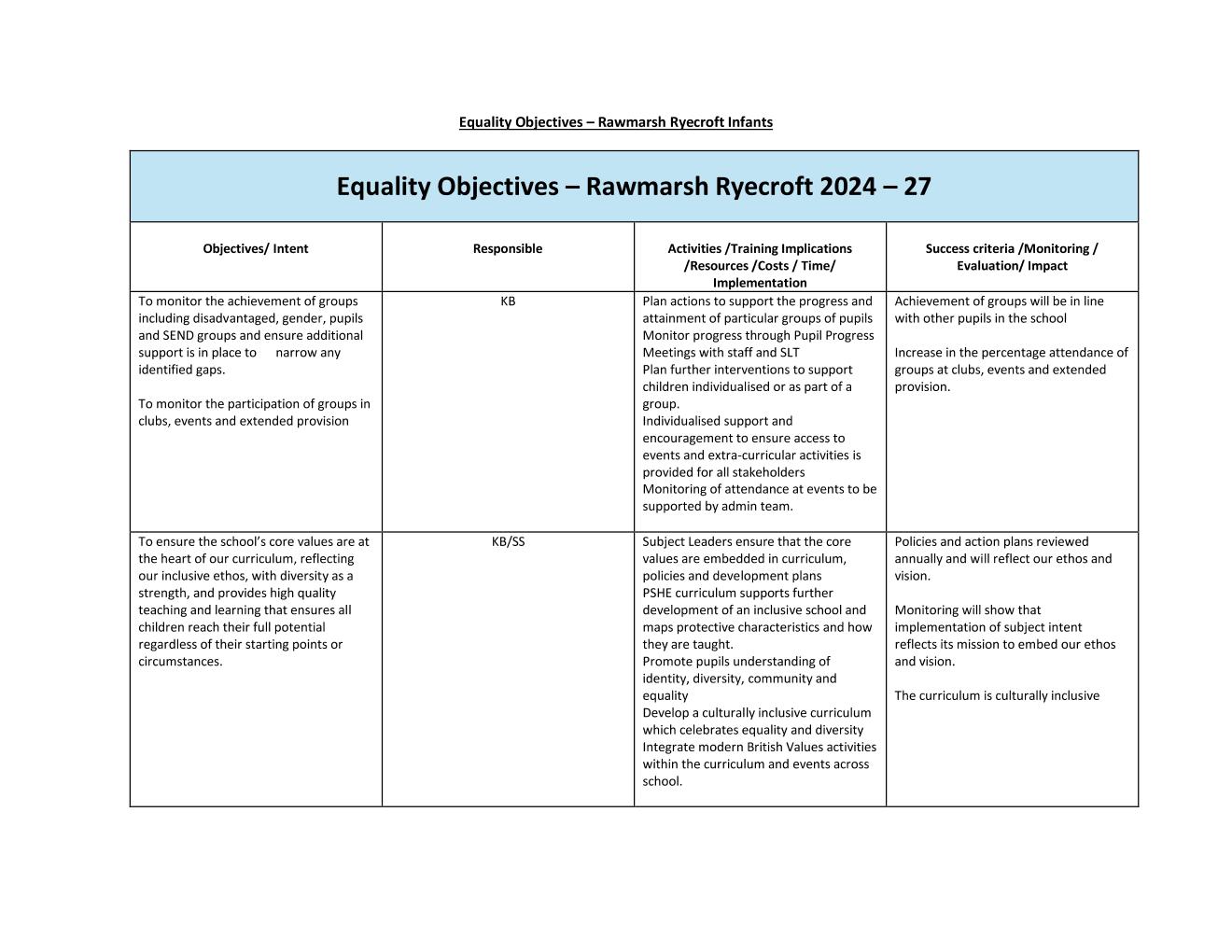

|
Equality Objectives 2024-2027 | [pdf 110KB] |

|
Public Sector Equality Duty
The information provided in this section shows how we are meeting the public sector equality duty. We are required to have due regard for the need to:
A. Eliminate unlawful discrimination, harassment, victimisation and any other conduct prohibited by the Equality Act 2010
B. Advance equality of opportunity between people who share a protected characteristic and people who do not share it
C. Foster good relations between people who share a protected characteristic and people who do not share it.
The information below is a summary of how we have due regard to the need to eliminate discrimination and inequality.
- We are aware of the requirements of the Equality Act 2010 that it is unlawful to discriminate, treat some people less fairly or put them at a disadvantage.
- Our school governors, have been briefed on their legal responsibilities under the Equality Act 2010, and are involved in supporting the school to meet its public sector equality duty.
- We try to keep an accurate record, when possible and appropriate, of the protected characteristics of our pupils and employees.
- We have a school Behaviour Policy that outlines our expectations of both pupils and staff in their interactions with each other, including our approach to tackling bullying and prejudice
- We deal promptly and effectively with all incidents and complaints of bullying and harassment
- We keep a record of all such incidents and notify those affected of what action we have taken.
- We provide training to all staff in relation to dealing with bullying and harassment incidents.
- We have a Special Educational Needs and Disabilities Policy that outlines the provision the school makes for pupils with special educational needs.
- Our Complaints Policy sets out the procedures through which we deal with any complaints.
- We aim to observe and implement the principles of equal opportunities and non- discrimination in our employment practices.
- We pay due regard within our recruitment practices, to safeguarding and protecting our pupils.
- We have procedures for addressing staff discipline, conduct and grievances
Please contact us if you would like to see copies of any of our school policies.
Consultation and Engagement
We aim to engage and consult with pupils, staff, parents and carers, and the local community, so we can develop our awareness of equality issues, learn about the impact of our policies, set equality objectives and improve what we do. We actively seek to consult and involve those stakeholders effected by inequality in the decisions we make about our school, to promote equality and eliminate discrimination. Our main activities for consulting and engaging are:
- Consultation with pupils through Pupil Leadership Team, pupil survey and feedback from pupil voice in an age appropriate way.
- Staff surveys and feedback from staff
- Parents evenings, feedback from parent survey, parental complaints and feedback.
- Contact with local community groups, feedback from other agencies and community links